They Won’t Even Let Them Bark: 10 Ugly Truths in India’s Draft Lab Animal Rules 2026
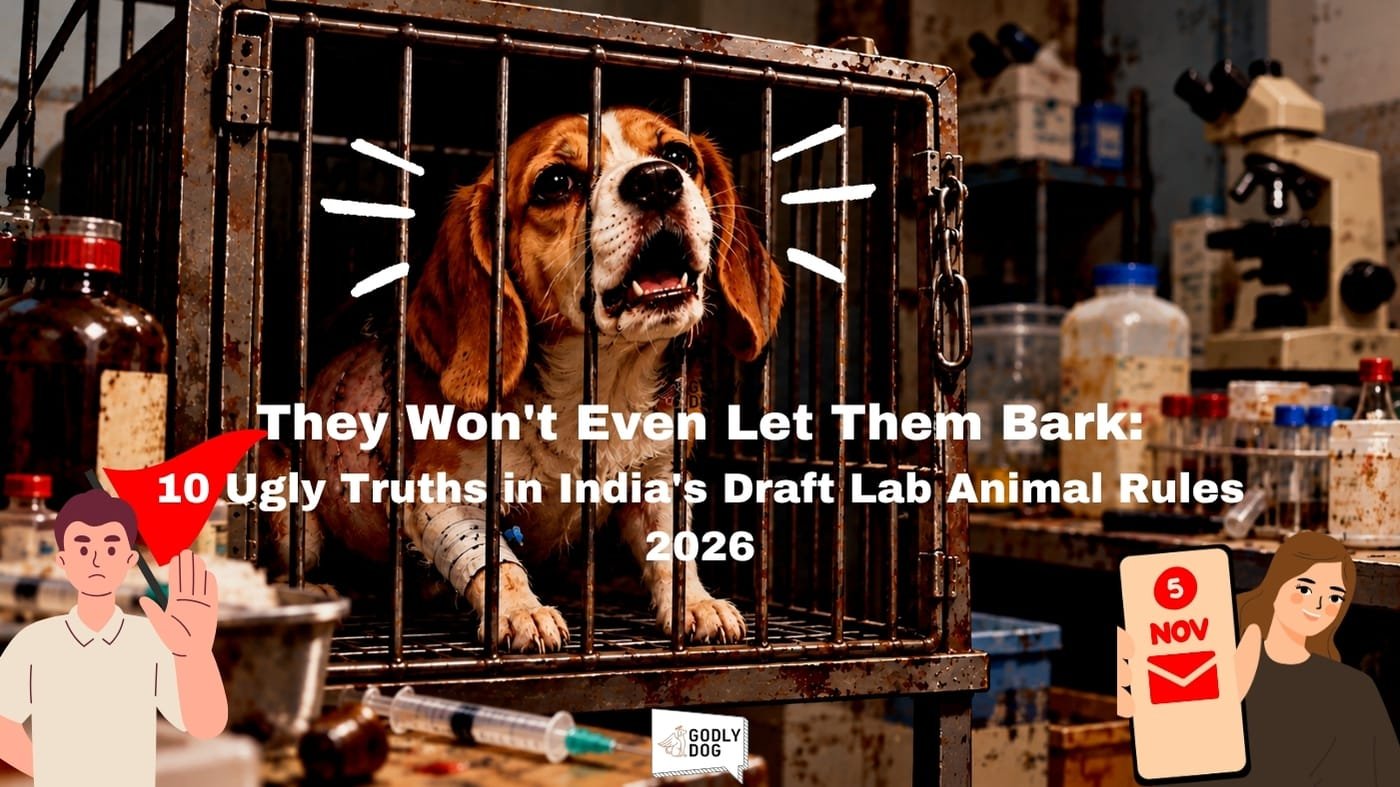
Back in 1998, India mandated that dogs held for experiments shall not be debarked. No cutting their vocal cords. No silencing them so the people hurting them don’t have to hear it. This government’s new Draft Lab Animal Rules 2026 drops that line. Quietly!
And it isn’t the only safeguard to go. Compulsory anaesthesia, rehabilitation after experiments, independent approval, the ban on paralysing drugs without anaesthesia: ALL GONE! And the document doing it has the nerve to call itself the Prevention of Cruelty to Animals Rules?!
India’s Draft Lab Animal Rules 2026: Commonly Asked Questions Answered
| 1. What is India’s Draft Lab Animal Rules 2026? | A new rulebook for every animal lab in India: the Draft Prevention of Cruelty to Animals (Control and Supervision of Experiment, Breeding and Trading of Laboratory Animals) Rules, 2026, G.S.R. 864(E). It would replace the 1968 and 1998 rules. It decides who approves experiments, how pain is graded and where labs can get animals. |
| 2. Who issued India’s Draft Lab Animal Rules 2026? | CCSEA (earlier CPCSEA), the Government of India’s statutory regulator for animal experiments, under the Department of Animal Husbandry and Dairying. Yes, the same department behind the 2023 Livestock Bill that tried to class dogs and cats as livestock. |
| 3. Whom does India’s Draft Lab Animal Rules 2026 affect? | Every vertebrate animal used, bred or traded for experiments in India: dogs, monkeys, rats, rabbits, farm animals, birds, fish and wild animals. Even community dogs, through an exemption that an undefined “competent authority” can grant (Rule 5(3)). |
| 4. Why is India’s Draft Lab Animal Rules 2026 dangerous? | A lab’s own committee could approve mild and moderate experiments on any species, dogs and monkeys included, with no prior approval from CCSEA (Rule 11(3)). It drops the 1998 rules that ban debarking lab dogs and require anaesthesia for painful procedures. Labs could also run from open or mobile facilities, while the fine for breaking the rules stays at ₹200. |
| 5. How do I object to India’s Draft Lab Animal Rules 2026? | Use the ready-made letter at Animal Writes or the template at the end of this blog. Add your name, city and one line in your own words, send it from your own email, and ask for an acknowledgment. 2 minutes. (Personalised letters count far more than copies.) |
| 6. Where do I send my objection? | Email cpcsea-mef@gov.in. Or post it to the Member Secretary, CCSEA, Near State Bank of India, Delhi Milk Scheme Complex, Shadipur, Delhi 110008. |
| 7. When is the deadline for the objection? | 5 November 2026. The draft was published in the Gazette on 6 October 2026, and the public got just 30 days. Some reports say 6 November, so don’t risk it. Send yours now. |
Inside India’s CCSEA Draft Lab Animal Rules 2026: Top 10 Changes That Make Cruelty Convenient
1. Debarking Lab Dogs: The Draft Lab Animal Rules 2026 Drops India’s 1998 Ban on Cutting Vocal Cords
Rule 9(m) of the 1998 Rules says it in nine words: “dogs held for experimental purposes shall not be debarked.” It protects every dog in an Indian lab, beagle or not. Now go through the 2026 draft from the first page to the last annexure. The word isn’t there. Neither is the protection.
Debarking isn’t a harmless snip. It’s surgery to cut away vocal cord tissue, and the American Veterinary Medical Association’s own literature review says it takes away a normal dog behaviour and carries serious health and welfare risks. A dog in pain barks. A dog in fear barks. So who exactly gains from a silent lab?!
2. IAEC Self-Approval: Labs Could OK Mild & Moderate Experiments on Dogs & Monkeys
Today, experiments on large animals like dogs and monkeys need a yes from the national regulator, CCSEA. The draft changes what decides who says yes. It’s no longer how big the animal is, but how much the experiment is expected to hurt: mild, moderate, severe or non-recovery.
And who decides that label? The lab’s own vet, sitting on the lab’s own ethics committee (Rule 11(10)). Mild and moderate experiments on any species, dogs and monkeys included, then go only to that committee and “shall not be referred” to CCSEA (Rule 11(3)). CCSEA only gets progress reports, after the approval is already given (Rule 11(4)). A report is not a permission!
Who sits on that committee? Nine members. Five are the lab’s own people, and the lab picks the chairperson. Very independent. Very reassuring.
Mild and Moderate Animal Experiments: What the Draft Lets Labs Approve
The draft’s own list of “moderate” experiments (Annexure I) includes:
- ➤ inducing tumours
- ➤ radiation or chemotherapy at doses that would otherwise kill, followed by rebuilding the immune system
- ➤ up to five days in a metabolic cage with movement restricted
- ➤ stimuli the animal cannot escape or avoid
- ➤ diets that don’t meet its nutritional needs, enough to make it moderately sick
- ➤ minor surgery
The “mild” list includes dosing through a tube down the throat, ear and tail biopsies, painful stimuli the animal can get away from, and diets that make it mildly sick. Mild for whom, exactly?!
Palamur Biosciences Beagles Case: What Inspectors Found (Even With CCSEA Approving)
This isn’t hypothetical. Palamur Biosciences is a CCSEA-registered contract research lab and beagle breeding facility in Mahabubnagar, Telangana. In June 2025 it was inspected by a committee authorised by CCSEA itself.

PETA India activists stage a protest in Hyderabad, calling for the release of beagles from Palamur Biosciences.
Photo credit: PETA India.
Trigger warning: Graphic images of animal suffering
I chose not to reproduce the disturbing images in this blog. If you want to see the evidence for yourself, please read PETA India’s report on Palamur Biosciences.
According to whistleblower reports cited by PETA India, around 1,500 dogs were crammed into overcrowded cages, with some confined to spaces meant for just two. Stressed dogs reportedly bit one another, leaving them with bloodied, torn ears. Dogs with treatable conditions were allegedly killed rather than treated, and more than 100 were reportedly killed in a single incident because they were deemed no longer “useful.” Whistleblowers also described chemicals injected under dogs’ skin that caused severe infections, drugs forced down their throats that reportedly led to vomiting blood and deaths, and dogs suffering broken bones from rough handling.
Police then registered what was reported as India’s first FIR against an animal experimentation lab, and in December 2025 the US FDA sent the lab a warning letter over violations of its lab practice rules.
If This Is What Oversight Looks Like, Picture Self-Regulation Under India’s Draft Lab Animal Rules 2026!
Now the point is, all of this happened under today’s rules, where CCSEA has to approve experiments on dogs. Even then, inspectors were worried enough about Palamur’s own ethics committee, the in-house panel that clears its experiments, to ask for a detailed audit of it. Under the draft, a committee like that would be the only one saying yes to mild and moderate experiments on dogs, and CCSEA would only hear about them through reports. If this is what inspectors found with the regulator still approving, imagine what happens when the lab’s own committee is the only one deciding!
3. India’s Draft Lab Animal Rules 2026 Makes Anaesthesia No Longer Compulsory in Animal Experiments, If Labs “Justify” It

Since 1998, Rule 9(d) has been non-negotiable. Anything more severe than a simple injection or a surface blood draw must be done under anaesthesia, given by a trained person who stays with the animal until it’s over. The draft drops it.
Now look at the draft’s own application form (Schedule III). Item 10(g) asks whether the protocol will prohibit anaesthetics or painkillers during painful procedures. If yes, “justify.” That’s the safeguard now. A paragraph on a form.
Two more 1998 protections vanish along with it. Paralysing drugs like curare were allowed only with anaesthesia deep enough to knock the animal unconscious, because a paralysed animal still feels everything; it just can’t move to show you. And chemicals could not be put into an animal’s eyes in a way meant only to cause pain. Neither line exists in the draft. What does exist, in its list of example “severe” experiments, is opening an animal’s chest “without adequate analgesia.” They wrote that down. As an example.
Already furious? Don’t wait till the end. Send your objection. The letter is ready at Animal Writes.
Pick your points, add your name, city and one line in your own words, and send it from your own email. 2 minutes.
#SayNoToAnimalExperimentationBill
4. The “Severe” Animal Experiments List: Allowed, Not Banned in India’s Draft Lab Animal Rules 2026
The draft (very kindly) bans exactly one kind of experiment outright: severe pain that’s likely to last long and can’t be relieved (Rule 7(2)). Everything else on its severe list is allowed, with CCSEA’s approval, for animals bigger than rodents and rabbits (Rule 11(2)). That list includes:
- ➤ inescapable electric shock “to produce learned helplessness”
- ➤ complete isolation of social animals for long periods, with dogs and monkeys named as the example
- ➤ tumours that are allowed to ulcerate
- ➤ causing unstable fractures, or trauma to bring on multiple organ failure
- ➤ toxicity tests where death is the endpoint
By the way, Learned helplessness was discovered in 1967 by giving dogs electric shocks they could not escape. They stopped trying to get away, even once escape became possible. Nearly 60 years later, India’s draft lists it like an item on a menu.

Image Source: Better Help (.com)
And for rats, mice and rabbits, the most-used lab animals of all, the draft doesn’t even bother to say who approves severe experiments!
5. After Experiment No Mandatory Rehabilitation: Lab Animals Can Be Reused or Euthanised
In 2006, India did something rare and decent. An amendment made researchers responsible for the aftercare and rehabilitation of animals once experiments ended. They could put an animal down only in three situations: paralysis or loss of basic functions, recurring pain, or a threat to humans or other animals. And the cost of caring for that animal for its whole expected life had to be built into the research budget.
What Freedom Looked Like for Lab Dogs
156 beagles were released from a pharmaceutical laboratory in Bengaluru in 2016 and handed over for rehabilitation and rehoming. The clip shows the dogs getting their first experience of life outside laboratory confinement, finally having the chance to feel the sun, touch grass, and begin life anew, with care, freedom, and the possibility of a loving home.
The dogs, aged between 2 and 5, have never been exposed to the outside world. As they have lived their entire lives in cages, they have no semblance of a normal life and can’t associate with any emotion. Not only have they not been toilet-trained, they can’t even climb stairs, play with toys or respond to sounds.
_Deccan Herald
Enjoy the video (published by Mint).
https://youtu.be/6FY4d2VbZGI
India’s Draft Lab Animal Rules 2026 Keeps None of This As a Rule
Its rules apply until an animal is “euthanized” or rehabilitated (Rule 1(6)), either one, and rehabilitation is left to future guidelines and a researcher’s promise to follow them “wherever required.” The draft also allows animals to be reused in further experiments. What it does spell out in full detail is a euthanasia register: date, species, chemical, dose, signatures (Rule 15(4)).
So no, they didn’t forget the dogs. They made a register for their deaths.
6. The Street Dog You Feed: As Per India’s Draft Lab Animal Rules 2026 An “Undefined Competent Authority” Can Allow Testing on Stray Dogs!
If you feed community dogs, you already know how fragile their legal protection is. Rule 5(3) says stray and feral animals “shall not be used” in experiments, then lets “competent authorities” grant exemptions (Rule 5(3)). Who is this competent authority? The draft has 23 definitions. This isn’t one of them.
Paranoid? No. I just have a memory. On 19 September 2022, this same regulator told every registered lab that stray dogs may be used for new vaccine trials and challenge studies, where a vaccinated animal is deliberately infected to test whether the vaccine works. The same circular allowed dogs brought to clinics to be used for safety and potency tests of established vaccines.

It was withdrawn on 5 October 2023, “till further orders.” Not forever. Till further orders. And now the draft writes the exemption straight into the rule!
People Are Already Taking to the Streets
Animal-welfare group Peedus People protest at Chandigarh’s Sector 17 Plaza and Elante Mall, on 23rd October, warning that the draft rules could put community dogs and other animals at risk of experimentation. Volunteers carried a stark message: “Every animal in India is at risk.” Read the report in The Tribune.
Objections Work. This Department Has Backed Down Before.
This draft comes from the Department of Animal Husbandry and Dairying. In June 2023, the same department published a draft Livestock Bill that would have put dogs and cats in the same category as cattle and poultry: commodities to be traded and exported. People made noise, loudly, and it was withdrawn in 13 days. I wrote all about that fight (and more) in my Ohh My Dog review.
That’s what objections do. Every objection sent within the 30 days has to be considered before these rules become final. Personal letters with a name, a city and a line in your own words count for far more than copy-paste ones.
Send your objection now: use the ready to use letter at Animal Writes, or write directly to cpcsea-mef@gov.in (template at the end). Deadline: 5 November.
7. No Proper Labs Needed: Open-Air, Mobile Facilities (anything under the sun) Works in India’s Draft Lab Animal Rules 2026

Under the draft, an “establishment” includes a place “not wholly enclosed or covered” and “mobile facilities” (Rule 2(i)). No walls. No roof. On wheels. People For Animals (PFA) pointed out that by this definition, you could technically run experiments from a three-wheeler!
Picture a two-wheeler. A cowshed. Let your imagination run wild! Who’s checking?
8. Not Just Dogs: This Draft Doesn’t Spare Anyone (Monkeys, Horses, Farm Animals, Birds & Fish, Protected Wildlife; No One’s Off-Limits)

Dogs are my heart, but all animals matter, and this draft exposes everyone:
- ➤ Monkeys: usable for basic research “aimed at the advancement of knowledge,” not only to fight life-threatening disease (Rule 6).
- ➤ Horses: “bleeding/blood products” is listed as a purpose of experiments (Rule 4(8)). In India, antivenom is made by injecting horses with venom and bleeding them for the antibodies.
- ➤ Farm animals, birds and fish: if registered breeders run short, labs can buy them from the open market or unregistered sellers, with only their own committee’s nod (Rule 21(2)). Today, any other source needs written permission from a legal authority.
- ➤ Wild animals: off-limits, unless an authority grants an exemption. And if a captured wild animal is injured, even the duty to ease its suffering can be waived on “scientific justification” (Rule 5(2)).
- ➤ Protected wildlife: species protected under the Wildlife (Protection) Act can be used too, with justification and permission (Rule 5(1)).
PETA India has called for the draft to be withdrawn, flagging exactly these risks to wildlife and community animals.
9. Animals as Classroom Tools: 5 Year Teaching Approvals & Surgery Practice on Animals (while the world moves to non-animal methods)
The draft lists higher education and professional training as reasons to use animals (Rule 4(6)). A lab’s committee can approve a whole class of teaching experiments for up to five years at a time (Rule 11(11)). Five years. One approval.
The first examples on its “non-recovery” list are laparoscopic, robotic and major invasive surgery training on animals. Non-recovery means the animal never wakes up. The 1998 Rules also banned experiments done just as an illustration or as a public demonstration. Gone too.
Meanwhile, India’s own drug rules were amended in March 2023 to accept non-animal methods like cell-based assays, organ chips and computer modelling. So why is this draft dragging classrooms back to the animal?!

All this while a wonderful option exists. Virtual dissection offers a humane alternative to animal experimentation in education. Image credit: The Spokesman
10. Who Holds Animal Labs Accountable? Advance-Notice Inspections & a ₹200 Fine!
Who’s watching the watchers?
- ➤ CCSEA’s own inspection team visits “with prior intimation” (Rule 24(4)). Nothing says surprise check like a heads-up.
- ➤ Unless the animals face an imminent risk, a lab caught breaking the rules gets a notice and 15 days to fix things first (Rule 25).
- ➤ Only the lab can appeal a decision (Rule 26). The person who complained? No such route!
- ➤ The fine for breaking the committee’s conditions is still up to ₹200, set by Section 20 of the 1960 Act. Only Parliament can change it, and it hasn’t. ₹200, for breaking the very conditions meant to protect a living, feeling animal.

Had Enough of India’s Draft Lab Animal Rules 2026? Just Spend Two Minutes to Object.
Kalki Koechlin, Abhirami and Nafisa Ali have spoken up. So have Maneka Gandhi, Ambika Shukla and PETA India. But celebrities don’t decide this. Public objections do, and every single one counts until 5 November.
Here’s How to Object
➤ Easiest: open your pre-written letter at Animal Writes, pick your points, add your name, city and one line, and send it from your email.
➤ Or write your own to cpcsea-mef@gov.in and ask for an acknowledgment. (Or use the template below.)
➤ Forward this blog to people who love animals. One letter is one voice. More is a chorus.
#SayNoToAnimalExperimentationBill
Strongly. Loudly. Unanimously.
Objection Template
To: cpcsea-mef@gov.in
Subject: Objection to the Draft Laboratory Animals Rules, 2026 (G.S.R. 864(E))
To the Secretary, Department of Animal Husbandry and Dairying, through the Member Secretary, CCSEA
I strongly object to the draft rules notified as G.S.R. 864(E) and request these changes:
➤ Rule 11(3): all experiments on animals above rodents and rabbits must keep needing CCSEA approval, whatever their pain label.
➤ Restore 1998 Rules 9(d) (anaesthesia), 9(j) (no paralysing agents without anaesthesia), 9(l) (no painful eye tests) and 9(m) (no debarking of dogs).
➤ Restore the 2006 duty of aftercare and rehabilitation, with euthanasia only in the situations it defined.
➤ Rule 5(3): no exemptions for stray, community or clinic animals.
➤ Rule 5(2)(c): delete the waiver on easing an injured wild animal’s suffering.
➤ Rule 2(i): remove unenclosed and mobile facilities from “establishment”.
➤ Rule 21(2): remove open-market and unregistered sourcing.
➤ Rule 24(4): allow unannounced inspections.
➤ Rules 4(6) and 11(11): no animal use in education where non-animal methods exist, and no five-year approvals.
Please acknowledge receipt of this objection.
Sign with your *NAME* & *CITY*.
Silence is exactly what this draft is counting on. Theirs and ours. Don’t give it yours!
India’s Draft Lab Animal Rules 2026: Additional FAQs
Yes. Section 14 of the Prevention of Cruelty to Animals Act, 1960 allows animal experiments for medical and scientific knowledge, as long as labs follow the rules made by CCSEA. That’s exactly why these rules matter so much: they decide what labs can do to animals.
No. India banned testing cosmetics on animals in 2014, and banned importing cosmetics tested on animals from November 2014. That ban sits in the Cosmetics Rules, so this draft doesn’t touch it. The draft covers research, drug and vaccine testing, and education.
Yes, it’s the same body. CCSEA (Committee for Control and Supervision of Experiments on Animals) is the national regulator for animal experiments, set up under the PCA Act. It was called CPCSEA until 2023, so you’ll still see both names online.
It’s the in-house ethics committee every registered lab must have. Under the draft, it has nine members: five from the lab itself and four nominated by CCSEA. The lab picks the chairperson (Rule 16). Today, IAECs approve experiments on small animals like rats and mice. The draft would let them approve mild and moderate experiments on every species.
The Breeding of and Experiments on Animals (Control and Supervision) Rules, 1998, amended in 2001 and 2006, are still in force. The 2026 draft only takes effect once a final version is published in the Gazette. Until then, the 1998 protections on anaesthesia, debarking and rehabilitation still apply.
Yes. CCSEA-registered labs breed and use dogs, especially beagles. Palamur Biosciences in Telangana, for example, runs a beagle breeding facility alongside its contract research lab. Today, experiments on dogs need CCSEA’s approval. Under the draft, mild and moderate ones would need only the lab’s own committee.
The draft says strays “shall not be used”. But an undefined “competent authority” can grant exemptions (Rule 5(3)). Two conditions apply. First, there must be an essential need: studies on animal health and welfare, or a serious threat to the environment or to human or animal health. Second, there must be a scientific justification that only strays will do. Those conditions are broad enough to worry anyone who feeds a street dog.
Only a few things. It bars experiments causing severe pain that is likely to last long and can’t be relieved (Rule 7(2)). It also bars using primate species listed under the Wildlife (Protection) Act (Rule 6(2)), and chemicals banned by any authority unless needed for testing (Rule 15(3)). Everything else, including inescapable electric shock is allowed with the right approval.
Yes. Since March 2023, India’s New Drugs and Clinical Trials Rules accept non-animal methods such as cell-based assays, organ chips and computer modelling. Yet the draft asks labs to use alternatives only “wherever possible” (Rule 3), with no list of methods they must check first.
Yes. Groups like Freagles rehome beagles retired from labs, and many go on to live happy lives in families. Under the 2006 amendment, researchers had a duty to rehabilitate animals after experiments. The draft makes rehabilitation optional, “wherever required”. If you’re open to adopting, a retired lab dog deserves a look (here’s why adopting matters).
Anyone can object, including people outside India. The notification doesn’t limit who can write, and under Section 23 of the General Clauses Act, objections from any person received before the deadline must be considered. Personal letters with your name, city and a line in your own words count as individual responses, unlike identical copies. Indian residents writing in large numbers will carry the most weight.
1. The rule numbers you object to, like Rule 11(3) or Rule 5(3)
2. The specific change you want
3. One personal line about why it matters to you
Send it from your own email, addressed to the Secretary, Department of Animal Husbandry and Dairying, through the Member Secretary, CCSEA. Ask for an acknowledgment so you have proof it was received.
CCSEA reviews every objection and may revise the draft. The final rules are then published in the Gazette and take effect from that date (Rule 1(2)). That’s why numbers matter now: once the final rules are notified, changing them is far harder.

Srijana is the founder of Godly Dog & mum to 7 furkids, including 3 rescued Indies. A lifelong advocate for strays, she’s spent 12+ years on hands-on dog raising, community dog care, & rescue work. She’s studied canine psychology & nutrition, blending that formal knowledge with lived experience to share honest, practical advice for caregivers who believe, like her, that these godly souls deserve no less than the unconditional love they offer.
You May Also Like

Discover the Rare & Endangered Indian Dog Breeds You Didn’t Know Existed
Discover the guardians of India’s canine legacy. India is home to a rich variety of rare and endangered dog breeds, each with unique traits and [...]
Buying vs. Adopting a Dog: Discover the Hard-Hitting Hidden Realities before Deciding
Deciding between buying and adopting a dog is more than just a personal choice—it's a life-changing decision with emotional, ethical, and practical implications. This blog [...]